Court-Ordered Treatment: What Really Happens Next
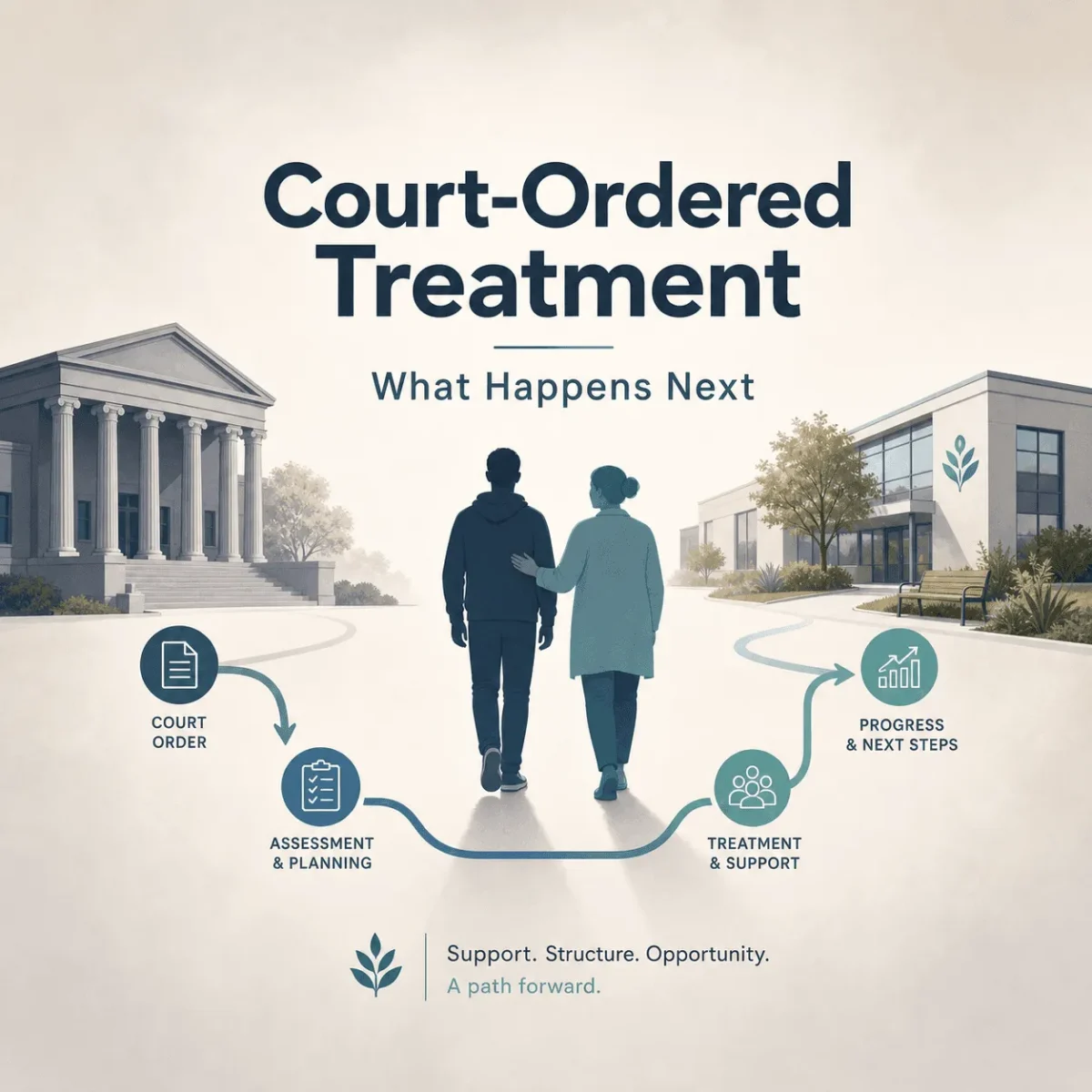
If you have never been through the court system, the phrase “court-ordered treatment” can sound like this big, cold, one size fits all thing.
Like you get a paper. You get dropped off somewhere. And then… you just “do treatment” until someone says you are done.
But in real life it usually feels messier than that.
People are stressed. Families are confused. Somebody is angry, somebody is relieved, somebody is both. And the person who actually has to go to treatment is often thinking one question on repeat.
What happens next? Like, literally next.
This is that. A plain English walk-through of what court-ordered treatment often looks like after the judge says it, plus what you can do to make it go smoother (and safer) for everyone.

First, what “court-ordered treatment” usually means
Court-ordered treatment is treatment you are legally required to attend. Not “recommended.” Not “strongly encouraged.”
Required.
It can show up in different ways:
- As a condition of probation
- In lieu of jail time (sometimes called diversion)
- As part of drug court or mental health court
- As a condition to get charges reduced or dismissed
- As part of a child custody or family court matter
- Sometimes after a civil commitment process (varies a lot by state)
And here is the part people miss. The court is not always choosing a specific facility. The court is usually ordering a level of care, a set of rules, and proof that you complied.
The details matter. A lot.
So step one is always to understand the exact terms of the order. This might include understanding how to communicate with your employer about needing to attend treatment, or navigating the complexities of substance abuse treatment which could be part of your court-ordered requirements.
It's also essential to be aware that if you're dealing with issues like Kratom addiction, specialized treatment may be necessary. Furthermore, if you're located in Maryland and seeking addiction treatment, crossing state lines for recovery could prove beneficial.
In some instances, individuals may face co-occurring disorders as part of their treatment journey which requires a comprehensive approach to recovery.
Step 1: You get the order. Then the clock starts
After the hearing, you will typically get paperwork that includes:
- The requirement (assessment, detox, residential, IOP, counseling, etc.)
- A timeline (by this date, within 24 to 72 hours, within 10 days, etc.)
- Reporting requirements (who gets updates, how often)
- Testing requirements (urine screens, breathalyzer, patch, etc.)
- Consequences for noncompliance
If you are thinking, “I’ll deal with it next week,” that is how people end up with a violation.
Even if you are overwhelmed, treat the timeline like it is real. Because it is.
Step 2: Usually there is an assessment before there is “treatment”
A lot of court-ordered cases begin with a substance use assessment, sometimes called:
- Alcohol and drug evaluation
- Clinical assessment
- SUD assessment
- Bio psychosocial assessment
This is where a licensed professional asks questions about:
- Substance use history (what, how much, how often, last use)
- Withdrawal risk
- Mental health symptoms
- Medical history and medications
- Legal history
- Housing, work, support system
- Safety risks (self-harm, harm to others)
Then they recommend a level of care. It might be:
- Medically supervised detox
- Residential treatment (inpatient rehab)
- Partial hospitalization (PHP)
- Intensive outpatient (IOP)
- Standard outpatient
- Individual therapy and education classes
- Medication-assisted treatment (MAT) with monitoring
If you are hoping to “talk your way into” the lightest option, just know this. If you minimize and then relapse or overdose, it gets worse fast. Clinicians are not trying to punish you. They are trying to keep you alive and stable enough to finish what the court requires.
Step 3: Placement. Where do you actually go
After the assessment, placement usually depends on three things:
- What the assessment recommends
- What the court will accept
- What is realistically available (bed openings, insurance, location, transportation)
If detox is recommended, you may go first to detox, then step down into residential or outpatient.
If residential is recommended, you might go directly to a residential facility once a bed is available.
If outpatient is recommended, you might start within days, sometimes with very specific attendance and testing rules.
This is where families tend to panic because they imagine “one place” that does “everything.” Many programs are part of a continuum. You might move levels of care as you stabilize.
And yes, you can sometimes travel out of county or out of state. But you need it approved when the court requires it. Do not assume.
Step 4: Intake day. The part nobody describes well
Intake is not a therapy session. It is logistics. It can take hours.
Common parts of intake:
- Identity verification
- Signing releases (especially if the court/probation needs updates)
- Medical screening (vitals, labs, meds reconciliation)
- Withdrawal screening if appropriate
- Belongings check (safety)
- Orientation to rules and schedule
- Initial clinical interview
- Sometimes a urine drug screen on arrival
Emotionally, intake can feel like a crash landing. Even if someone wanted treatment, the first day can still feel humiliating or scary. You are tired. You are being watched. You do not know what you are allowed to do.
That’s normal.
If you are a family member, your job here is not to debate the rules with staff. The fastest way to help is to cooperate with the process, provide accurate medical info, and then give the person space to settle.
Step 5: The court compliance piece. How reporting actually works
This is the part that makes court-ordered treatment different.
Treatment programs typically provide some form of compliance reporting, often including:
- Proof of admission
- Attendance verification
- Progress updates (sometimes limited to participation, not details)
- Drug screen results if required and authorized
- Discharge summary and recommendations
- Documentation of completion
But there are privacy laws. Even court-ordered patients still have rights.
Programs generally cannot share your whole therapy content with probation or the court. Usually what gets shared is focused on compliance. Did you attend? Did you participate? Did you test positive? Did you leave early?
To make this work, you usually sign releases that specify:
- Who receives information (probation officer, attorney, court coordinator)
- What is shared
- For how long
If you refuse to sign releases when the court requires proof, that can be treated as noncompliance. Which is one of those painful technicalities people do not see coming.
Step 6: What treatment looks like day to day (not the movie version)
Whether it is residential or outpatient, most modern programs are structured and busy.
You will likely see some mix of:
- Group therapy (a lot of it)
- Individual therapy
- Psychiatric appointments if needed
- Medication management
- Relapse prevention planning
- CBT and skills work
- Trauma-informed therapy approaches (when appropriate)
- Family therapy or family education
- Recovery support groups
- Case management (legal, work, housing)
- Random or scheduled drug testing
In residential treatment settings like Britelife's women's residential treatment, your day is basically planned for you. In outpatient scenarios such as those offered by Britelife, you still have to manage life outside. Which can be harder than it sounds, especially early.
And here is an honest note. Court-ordered treatment sometimes starts as compliance, but turns into real engagement later. That shift can happen on week two, or week six, or not at all. But it is possible. People do change even when they did not “choose” it at first.

Additionally, certain aspects of treatment such as withdrawal management may be included in the program. It's also worth noting that intervention services play a crucial role in the transition from intervention to admission into these treatment programs.
Step 7: Drug testing. Yes it is stressful. Yes it matters
Testing protocols vary by court and program. Some people have:
- Random urine screens multiple times a week
- Breath tests
- Observed collections
- Hair testing in some cases
If you are in treatment and you test positive, what happens next depends on context:
- Was it a known relapse that you disclosed
- Was it a medication that was prescribed and verified
- Was it a substance that should not be present
- Are you otherwise participating and honest
- What does the court order say about “dirty tests”
Some courts treat a positive test as a violation. Others treat it as a clinical issue with stepped-up care. Drug court programs often use a mix of accountability and treatment adjustments.
The worst move is usually lying. Not because people are evil for lying. Because once trust collapses, the system gets more rigid, and you get fewer options.
Step 8: What if someone refuses. Or leaves
Leaving early, refusing intake, missing sessions, or repeatedly testing positive can trigger:
- A report to probation or the court
- A court date for a violation hearing
- Sanctions (increased testing, community service, curfew, jail time)
- A higher level of care requirement (residential after failing outpatient)
- In some cases, revocation of probation
Sometimes people assume they can “serve the time instead.” That is a legal decision, not a vibe. Talk to an attorney before making any moves. And if safety is a concern (suicidality, severe withdrawal risk), medical care has to come first regardless of legal consequences.
Step 9: Completion. What “done” actually means
Completion usually has a definition in the court order. It might mean:
- A specific number of sessions
- A minimum number of weeks
- A certificate of completion
- Negative tests over a period of time
- Payment of fees
- Continued aftercare participation
Some people finish residential but still have court requirements like:
- IOP for 8 to 12 weeks
- Weekly therapy
- Sober living
- Ongoing monitoring
So the “finish line” can be a series of finish lines.
Also, discharge is not always “graduation.” People can be discharged for:
- Completion
- Medical reasons
- Noncompliance
- Behavioral issues
- Insurance or funding changes
That is why it is smart to ask early: what counts as successful completion for my case.
Step 10: What families should do (and not do)
Families are often pulled into court-ordered treatment whether they want to be or not.
A few practical things that help:
- Get clarity on boundaries. Are you providing rides. Money. A place to live. What are the rules.
- Ask the program how family involvement works. Some have family therapy, education, or visiting protocols.
- Stop acting as the probation officer. You can support recovery without policing every moment.
- Prepare for emotional whiplash. Early recovery can be irritable and raw. That does not mean treatment is failing.
- Take care of yourself. Al-Anon, family therapy, support groups. It is not selfish. It is stabilizing.
And one thing not to do, if you can help it.
Do not use treatment as a constant threat. “If you mess up, I’ll tell your PO.” That dynamic can push people into hiding. And hiding is where relapse grows.
Common questions people ask, but quietly
“Is court-ordered treatment less effective?”
It can be. Or it can be the first doorway.
Motivation matters, yes. But structure matters too. Accountability can keep someone engaged long enough for insight to catch up. The better programs treat legal pressure as one factor, not the whole identity of the person.
“Can I choose where I go?”
Sometimes. Especially if the court order is broad, like “complete a licensed substance use treatment program.”
But you usually need the facility to meet certain requirements (licensed level of care, ability to report compliance, sometimes in-network insurance, sometimes local). In such cases, considering whether to seek treatment locally or travel could be beneficial.
“Will this go on my record forever?”
That depends on the legal arrangement. Diversion programs may lead to reduced charges or dismissal if completed. Probation conditions are different. Ask your attorney. Seriously.
“What if I have anxiety, depression, PTSD, bipolar”
Co-occurring mental health conditions are common, not rare. Treatment should address both. If you only treat the substance use and ignore the panic attacks or trauma symptoms, relapse risk stays high.
This is also why integrated programs, ones that can treat addiction and mental health together, tend to be a better fit for many people.

If you are trying to pick a program, look for these practical capabilities
Not marketing words. Practical stuff.
- Can they do a fast intake, especially if the court deadline is tight?
- Can they coordinate with probation or the court (with proper releases)?
- Do they offer medically supervised detox if needed?
- Do they treat co-occurring mental health conditions?
- Do they have step-down options (residential to PHP to IOP, or IOP to outpatient)?
- This is where understanding the importance of PHP and IOP after detox and residential treatment comes into play.
- Do they offer family services and aftercare planning?
- Do they help with insurance verification and admissions logistics?
If you are looking for a program that can support substance use treatment and co-occurring mental health care, BriteLife Recovery offers medically supervised detox, residential treatment, and outpatient options in multiple locations. They also provide admissions support that can help you understand next steps and verify insurance.
Moreover, BriteLife has specific programs like veteran-focused addiction treatment, which cater specifically to those who have served in the military. Additionally, their facilities often located in scenic nature-rich settings, which could enhance recovery experience significantly.
A last, honest note
Court-ordered treatment is not a magical fix. And it is not automatically a punishment either.
It is a structured chance. Sometimes the first real interruption in a cycle that has been running for years.
If you are the person going through it, try to focus on two things:
Show up. Tell the truth.
Not perfectly. Just consistently.
And if you are the family member watching this unfold, you do not need to solve the entire future this week. You just need to help get everyone through the next right step, safely.
Because that is what really happens next. One step. Then another.
FAQs (Frequently Asked Questions)
What does 'court-ordered treatment' mean?
Court-ordered treatment is legally required treatment you must attend as part of a court order. It can be a condition of probation, diversion instead of jail time, part of drug or mental health court, or involved in family court matters. The court usually specifies the level of care and rules rather than a specific facility.
What happens immediately after a judge orders court-ordered treatment?
After the hearing, you typically receive paperwork outlining your requirements (like assessment, detox, counseling), timelines for compliance, reporting and testing rules, and consequences for noncompliance. It's crucial to follow these timelines strictly to avoid violations.
Is there an assessment before starting court-ordered treatment?
Yes, most cases begin with a substance use or clinical assessment by a licensed professional. They evaluate your substance use history, mental health, medical background, legal history, and safety risks to recommend the appropriate level of care such as detox, residential treatment, outpatient programs, or medication-assisted treatment.
How is the placement for court-ordered treatment decided?
Placement depends on the assessment recommendations, what the court will accept, and what is realistically available including bed openings and insurance coverage. You may start with detox and then move to residential or outpatient care. Approval is needed if you plan to travel out of county or state for treatment.
Can I choose any facility for my court-ordered treatment?
Usually not. The court orders a level of care rather than a specific facility. Placement depends on assessment results, court approval, and availability. It's important to communicate and get approval if you want to attend a program outside your area or state.
What should I expect on intake day at a treatment program?
Intake day is not therapy but an administrative process where your information is collected and initial evaluations occur. It sets up your treatment plan based on the court order and assessment recommendations to ensure compliance with all requirements.