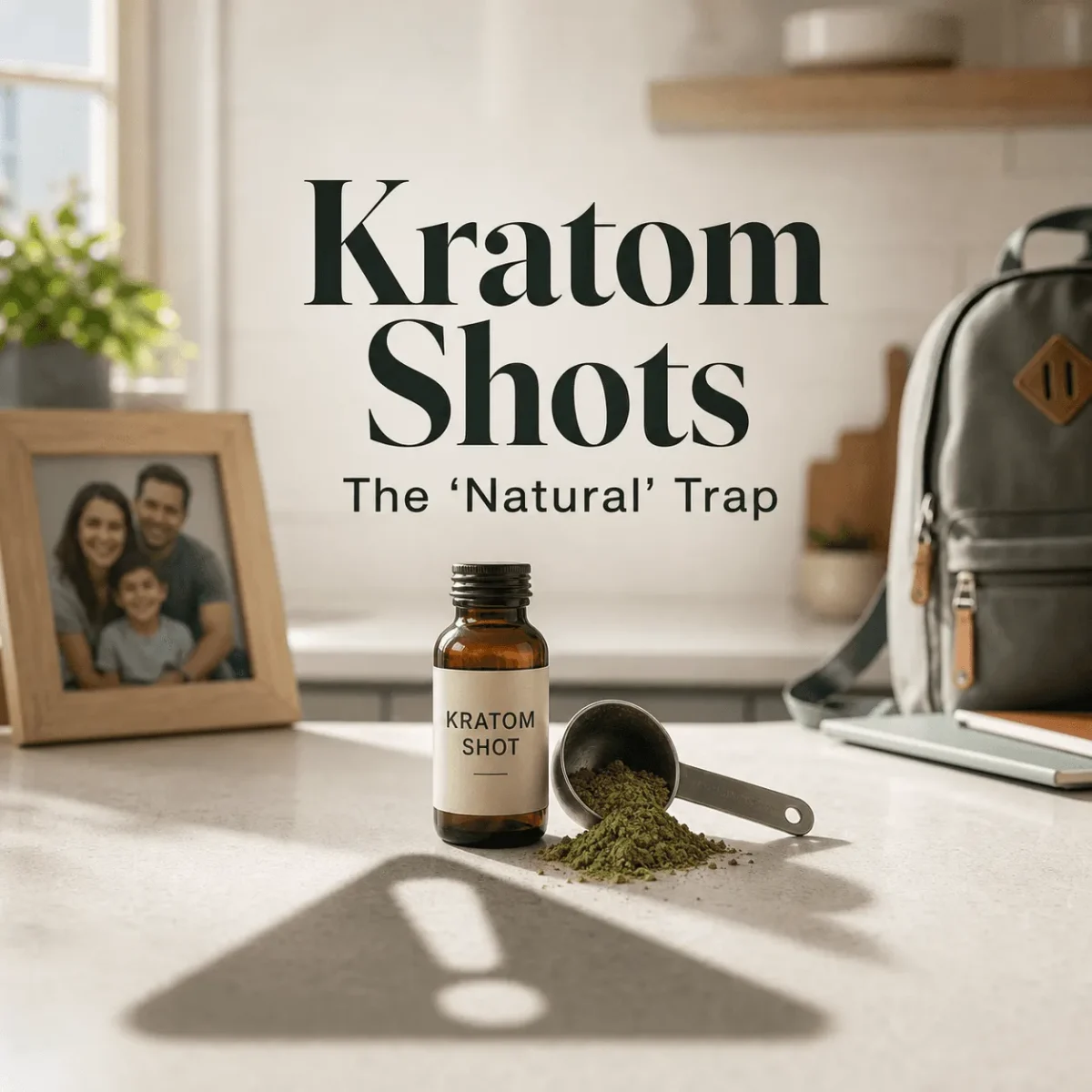
Kratom Shots: The ‘Natural’ Trap Families Miss
There’s this moment that happens in a lot of families now.
Someone finds a tiny bottle in a backpack. Or in the car console. Or tucked behind vitamins in the kitchen cabinet. It looks… harmless. Almost cute. Like an energy shot you’d grab at a gas station.
And then you read the label.
Kratom.
Sometimes it says “mitragyna speciosa.” Sometimes it says “botanical blend.” Sometimes it barely says anything at all, except a brand name and a warning in tiny print.
And the person holding it says, “It’s natural. It’s basically like coffee.”
That’s the trap. Not because kratom is always instantly catastrophic. But because the “natural” framing lowers everyone’s guard. Especially families. Especially parents. Especially partners who want to believe this is a phase, a supplement, a workaround.
Kratom shots are not a harmless wellness trend. They are concentrated, fast hitting, and easy to hide. They can also be the on ramp to dependence that nobody saw coming.
What kratom shots actually are (not what people say they are)
Kratom comes from a tree native to Southeast Asia. Traditionally, the leaves were chewed or brewed as tea in some communities.
But that’s not what most people in the US are using.
Kratom shots are usually liquid extracts, meaning you’re not dealing with ground leaf in a capsule. You’re dealing with a concentrated product, sometimes marketed as “extra strength” or “enhanced.”
And that matters because concentration changes the whole experience.
A shot can hit quickly. It can feel “clean.” It can feel like a mood lift, a warm calm, a burst of motivation, a softening of anxiety. At certain doses it can feel stimulating. At higher doses, sedating. That dual effect is part of why people keep reaching for it.
And it’s also why families get confused. Because the person using it may look fine at first. Or even better than usual.
Until they don’t.
The “natural” label is doing a lot of lying
Let’s just say it plainly. Natural does not mean safe.
Opium poppies are natural. Tobacco is natural. Poison ivy is natural. So the word itself doesn’t tell you much.
What “natural” does do is create this mental shortcut:
If it’s natural, it can’t be that addictive.
If it’s sold in stores, it must be regulated.
If it’s a plant, it’s probably gentle.
Kratom shots exploit that shortcut.
And because they’re often sold at vape shops, gas stations, smoke shops, even some convenience stores, the whole thing feels normalized. Like, why would this be next to the energy drinks if it was a big deal?
But availability is not the same thing as safety. It’s just availability.
Why shots are a different beast than kratom powder
This is one of the biggest details families miss.
Powder and capsules can still cause problems, absolutely. But shots tend to be where things escalate.
Why?
1. The dose is harder to understand
With shots, you’re often not getting a clear, standardized amount of active alkaloids. Labels may list “kratom extract” without telling you how strong it really is.
One brand’s shot can be wildly different from another’s. Even different batches can vary.
2. The effects are faster
Liquid extracts can kick in sooner. That quick reinforcement is how habits get built. Fast relief teaches the brain, “Do that again.”
3. They’re easier to hide and use repeatedly
A shot bottle is small. Tossable. Easy to buy daily. Easy to stash. Easy to use in a bathroom at work, in the car, before dinner, before bed.
4. The tolerance climb can be brutal
People often start with “just one.” Then one doesn’t hit the same. So it becomes two. Or a stronger brand. Or mixing with other things.
And the spending can get intense too. Some people end up dropping a shocking amount of money per week on shots. Quietly. Until the bank account tells the truth.

What dependence can look like, day to day
Families sometimes expect addiction to look like chaos right away.
But kratom dependence can be sneakier. It can look like:
- Someone who used to be present at dinner but now “needs to run out real quick”
- A partner who is strangely irritable in the mornings until they’ve had their “supplement”
- A college student who can’t focus without it, then can’t sleep without it
- A person who swears it helps anxiety, but their anxiety is now worse when they don’t have it
- Someone who suddenly has stomach issues, sweating, restlessness, and mood swings that come and go in cycles
People don’t always connect those dots. They blame stress. Hormones. Work. Depression. Anything except the little bottle.
And because kratom is talked about online like a wellness hack, users can get defensive fast. Like you’re accusing them of doing something “hard.”
They’ll say, “It’s not drugs. It’s kratom.”
But if you can’t stop, if you feel sick without it, if you’re organizing your life around it, we need to call it what it is.
Withdrawal is real. And it can be rough.
Not everyone experiences kratom withdrawal the same way, but many people report symptoms similar to opioid withdrawal, plus some that feel uniquely miserable.
Commonly reported withdrawal symptoms include:
- anxiety, agitation, irritability
- insomnia, restless legs
- sweating, chills, flu like feelings
- nausea, vomiting, diarrhea
- muscle aches, fatigue
- depressed mood, low motivation
- intense cravings
And here’s the part families really don’t expect.
Some people try to quit and can’t get through day two or three. Not because they’re weak. Because their body has adapted. The brain has adjusted to having that chemical support.
So they go back. “Just to taper.” “Just to function.” And the cycle tightens.
The hidden danger of mixing kratom shots with other substances
This is where things can get genuinely scary.
Some people combine kratom shots with:
- alcohol
- benzodiazepines (like Xanax, Ativan, Klonopin)
- sleep meds
- stimulants
- other opioids
- antidepressants or other psychiatric medications without medical guidance
Mixing substances increases risk. It can make sedation stronger, impair breathing, intensify mood instability, or lead to unpredictable reactions.
Even when someone is not mixing intentionally, it happens. A person with anxiety might already have a prescription. A person who drinks socially might not think twice about having a shot earlier in the day.
Kratom becomes the invisible variable.
Why teens and young adults are especially vulnerable
This is not just a “middle aged pain relief” thing anymore.
Shots are marketed with bright labels. Sold in places young people already go. Framed as a legal buzz. A focus tool. A chill button.
And young brains are more sensitive to reinforcement. The reward circuits learn fast. Habits imprint fast. Coping patterns form fast.
So if a teen learns, “I don’t have to feel uncomfortable. I can just take a shot,” that becomes a life strategy.
And it’s hard to unlearn.
The family blind spots (the ones that feel so reasonable)
Families miss kratom shots for a few reasons that make sense, honestly.
“They’re functioning”
Yes. Many people do function for a while. That doesn’t mean they’re okay. Functioning isn’t the opposite of addiction. It’s often the stage right before things fall apart.
“It’s helping them, though”
At first, it might. Especially if they’re self treating anxiety, depression, trauma, chronic pain, or opioid withdrawal. Relief can be real.
But relief that creates dependence is not a solution. It’s a trade.
“I don’t want to overreact”
This one is huge. People delay because they don’t want to be dramatic. Meanwhile, tolerance grows, money disappears, mood changes deepen, and the person gets more entrenched.
A calmer approach is good. Silence is not.
Signs it’s moved from casual use to a problem
You don’t need to catch someone passed out to take this seriously.
Red flags include:
- needing it to start the day, work, socialize, or sleep
- increasing dose or switching to stronger extracts
- hiding bottles, lying about use, getting defensive
- withdrawal symptoms when they try to stop
- money stress or frequent trips to smoke shops
- personality changes, emotional volatility
- neglecting responsibilities, hobbies, relationships
- using despite negative consequences
If you see several of these, the conversation shouldn’t be “Is this bad enough yet?”
It should be “What do we do now?”
How to talk about it without detonating the relationship
You want to go in like a prosecutor. I get it. But that often backfires.
Try this instead:
- Lead with concern, not accusation. “I’m worried about you.”
- Use specific observations. “I’ve noticed you get sick and irritable if you don’t have it.”
- Ask open questions. “Have you tried stopping? What happened?”
- Name the pattern. “It seems like this is becoming something you need, not something you choose.”
- Avoid the word “junkie” or anything shaming. Just don’t.
- Offer support and options. Not ultimatums right away.
If you’re a parent, also remember this: you’re not negotiating whether kratom is a plant. You’re addressing behavior, health, and safety.
When detox and treatment become the right call
Some people can taper off with medical guidance and strong support.
Others can’t. Especially if they’ve been using high dose extracts, using daily for a long time, or have co-occurring mental health issues. Or they’re mixing substances. Or they’ve tried quitting and keep relapsing.
This is where professional help matters.
A medically supervised detox can help manage withdrawal symptoms, monitor complications, and create a safer landing. Then the bigger work starts. Why was kratom needed in the first place? What pain was it covering? What coping skills were missing? What mental health pieces are untreated?
That’s why comprehensive programs exist.
If you’re looking for a place to start, BriteLife Recovery offers addiction and co-occurring mental health treatment, including medically supervised detox and residential care at multiple locations across the US. You can explore options or verify insurance at https://britelife.com.
Sometimes the most loving thing a family can do is stop trying to white knuckle it alone.

The uncomfortable truth: kratom can be a “bridge” that turns into a cage
A lot of people don’t start kratom because they want to party.
They start because they want to feel normal.
They’re anxious. They’re in pain. They’re burned out. They’re lonely. They’re coming off something else. They’re depressed and can’t get out of bed. They’re traumatized and can’t settle their body.
So the first time works. Of course they go back.
But then the baseline changes. The body starts asking for it. The mind starts bargaining for it. And the “natural supplement” becomes the center of gravity.
Families often show up late to this story because the early chapters look like improvement.
And that’s why kratom shots are such a trap. They don’t announce themselves like a crisis. They show up like a fix.
However, it's crucial to understand that kratom addiction is real and recovery is possible with the right support and treatment plan in place.
What families can do today, like literally today
If you found kratom shots in your home and your stomach dropped, here are practical next steps:
- Document what you’re seeing (frequency, behavior changes, spending, withdrawal signs). Not for a courtroom. For clarity.
- Have one calm conversation. Not ten fights.
- Ask directly about dependence: “Do you feel sick if you stop?” “Have you tried to quit?”
- Don’t debate internet talking points. Stay anchored to real life impact.
- Loop in a professional if there are withdrawal symptoms, mental health concerns, or polysubstance use.
- Get support for yourself too. Family stress is its own kind of erosion.
And if the person is willing, even slightly, that’s your opening. Use it.
You can contact a treatment team, ask about assessment, detox, and next steps. BriteLife Recovery is one option families use because they can help you figure out the right level of care, not just hand you a brochure. Again, the site is https://britelife.com.
The bottom line
Kratom shots are marketed like a wellness shortcut. But in a lot of families, they become a quiet crisis. Hidden bottles. Mood swings. Withdrawal. Denial. Escalation.
And the word “natural” keeps everyone asleep at the wheel for longer than they should be.
If someone you love is stuck in that loop, you’re not crazy for being concerned. You’re not overreacting for asking hard questions. And you’re not alone in this.
You just caught something many families miss. Now you can do something about it.
FAQs (Frequently Asked Questions)
What are kratom shots and how do they differ from traditional kratom powder?
Kratom shots are concentrated liquid extracts of the kratom plant, often marketed as "extra strength" or "enhanced." Unlike traditional kratom powder or capsules made from ground leaves, these shots deliver a fast-hitting, potent dose that can feel stimulating at lower doses and sedating at higher ones. Their concentrated form means effects come on quickly and can be more intense, making them easier to develop dependence on.
Why is the 'natural' label on kratom products misleading?
The term "natural" doesn't guarantee safety or lack of addiction. Many natural substances like opium poppies or tobacco are highly addictive and harmful. Kratom's "natural" label creates a false sense of security, leading families and users to underestimate its risks. Additionally, kratom shots are often sold in everyday stores alongside energy drinks, normalizing their use without proper regulation or safety assurances.
What makes kratom shots particularly risky compared to other forms?
Kratom shots pose unique risks because their dosage is often unclear and unstandardized, with potency varying between brands and batches. The liquid form causes faster onset of effects, reinforcing habitual use. Shots come in small, easily concealable bottles, making repeated use easy to hide. Users may experience rapidly increasing tolerance, leading to higher consumption and significant financial costs.
How can kratom dependence manifest in daily life?
Dependence on kratom can be subtle and may include behaviors like needing to leave meals abruptly to use it, irritability until the supplement is taken, difficulty focusing or sleeping without it, worsening anxiety when not using it despite claims of relief, and physical symptoms such as stomach issues, sweating, restlessness, and mood swings that fluctuate over time. These signs are often mistaken for stress or other health issues rather than substance dependence.
Is kratom withdrawal real and what symptoms might someone experience?
Yes, kratom withdrawal is real and can be challenging. Symptoms reported by many users resemble opioid withdrawal and include anxiety, agitation, irritability, muscle aches, insomnia, sweating, nausea, and mood disturbances. The severity varies among individuals but can significantly impact daily functioning during cessation attempts.
Why should families be cautious about accepting kratom as a harmless supplement?
Families should be cautious because the "natural" marketing of kratom lowers guard against its potential harms. Kratom shots are concentrated products that can quickly lead to dependence without obvious immediate problems. Because they are easy to hide and socially normalized due to their availability in common stores, users may develop escalating use patterns unnoticed until significant health or behavioral issues arise.